
Oman has become an attractive destination for international investors and businesses looking to expand their operations in the Middle East.
With its strategic location, modern infrastructure, investor-friendly policies, and growing economy, the Sultanate offers several opportunities for businesses across different industries. One of the major attractions is Oman’s Free Zone tax benefits: Special Economic Zones (SEZs) and Free Zones offer incentives designed to encourage foreign investment, support international trade, and promote industrial development.
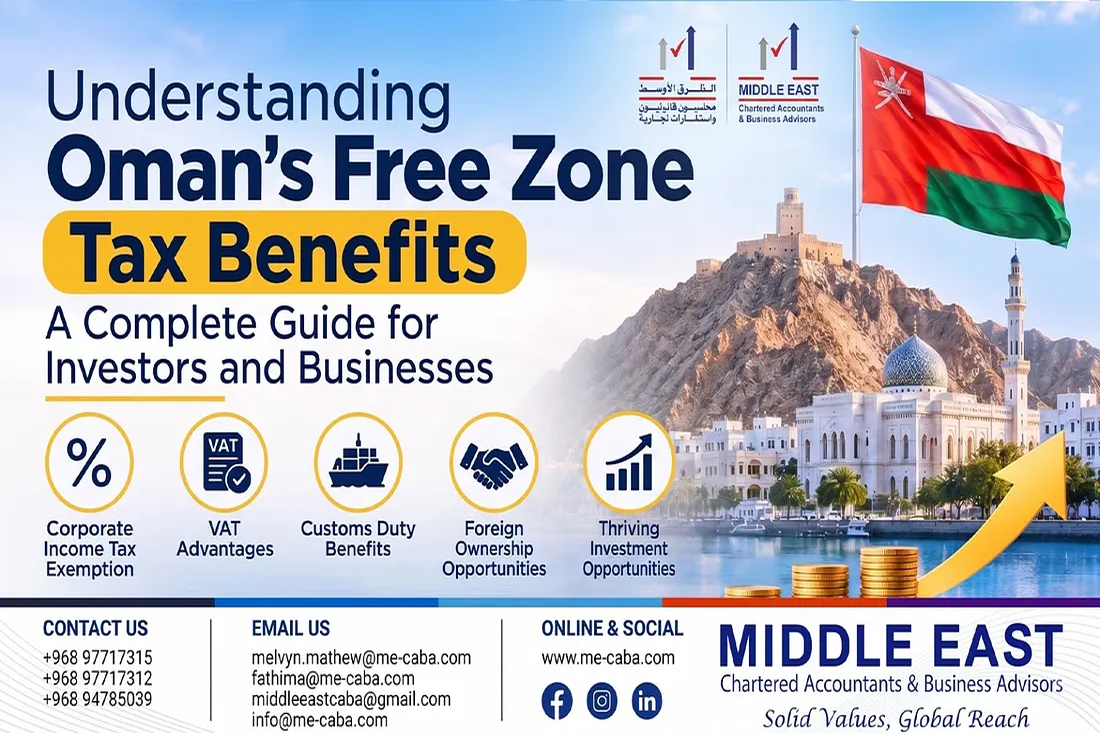
These incentives may include corporate income tax exemptions, customs duty benefits, foreign ownership opportunities, and simplified business procedures. However, understanding the eligibility criteria, regulatory requirements, and compliance obligations is essential before establishing a business in these zones.
In this guide, Middle Eastern Chartered Accountants (MECA) explains the key tax advantages, investment opportunities, and important considerations for businesses planning to operate in Oman’s Free Zones.
1. What Are Free Zones in Oman?
Free Zones and Special Economic Zones are designated areas established to attract domestic and international investment by providing businesses with specific commercial, operational, and financial incentives. These zones support industries such as:
The Public Authority for Special Economic Zones and Free Zones (OPAZ) oversees several of these zones and supports investment development across Oman. Some of the major investment destinations include:
Special Economic Zone at Duqm (SEZAD)
Suitable for large-scale industrial projects, manufacturing, logistics, energy, and infrastructure development.
Salalah Free Zone
Offers opportunities in manufacturing, logistics, warehousing, and international trade.
Sohar Free Zone
A strategic destination for petrochemicals, metal industries, manufacturing, and logistics.
Al Mazunah Free Zone
Provides opportunities for trading, warehousing, and cross-border commercial activities.
These locations offer different facilities and incentives depending on their regulatory framework and business focus.
2. Understanding Oman’s Free Zone Tax Benefits
Tax incentives are among the most attractive reasons for businesses to consider establishing operations in Oman’s Special Economic Zones and Free Zones. Under Royal Decree 38/2025, Oman introduced a unified Law of Special Economic Zones and Free Zones, which establishes a framework for tax exemptions and other investment incentives.
A. Corporate Income Tax Exemption
Qualifying enterprises and zone operators can apply for an exemption from taxes imposed under Oman’s Income Tax Law. Eligible businesses may receive an initial 10-year exemption from the commencement of business activities, plus two additional 10-year extensions for qualifying activities of a special nature. This means certain strategic and specialised businesses may potentially benefit for up to 30 years.
B. Value Added Tax (VAT) Advantages
Oman applies a standard VAT rate of 5%, but certain transactions involving designated Special Zones may qualify for zero-rating under specific conditions. Operating inside a Free Zone does not automatically make every transaction VAT-free, so proper VAT documentation and transaction records are essential.
C. Customs Duty Benefits
Eligible goods imported into designated zones may benefit from customs duty exemptions or suspension, which particularly helps re-export businesses. When goods enter Oman’s local customs territory, applicable duties and import requirements may arise, so accurate import, export, inventory and customs records are needed.
3. Other Investment Advantages of Oman’s Free Zones
Apart from tax incentives, businesses can benefit from several additional investment advantages.
100% Foreign Ownership
Eligible investors can establish businesses without an Omani partner, subject to applicable regulations.
Capital & Profit Repatriation
Permits full repatriation of capital and profits.
Strategic Location
Provides access to regional and international markets.
Customs Incentives
Eligible imports and re-exports may benefit from customs exemptions.
Business Infrastructure
Access to ports, logistics facilities, industrial land, and warehouses.
Business Facilitation
Streamlined licensing and administrative procedures.
These advantages make Oman an appealing destination for businesses looking to establish a regional presence and expand international operations.
4. Which Businesses Can Qualify for Free Zone Tax Exemptions?
Not every business operating within a Free Zone automatically qualifies for corporate income tax exemptions. Under Oman’s Executive Regulations issued through OPAZ Decision №81/2026, qualifying activities of a special nature may be eligible for extensions beyond the initial 10-year exemption. These activities include:
- Heavy manufacturing industries, including petrochemicals, minerals, and basic metals.
- Renewable energy, green hydrogen, and other green industries.
- Port logistics and cargo-handling activities.
- Advanced technology, artificial intelligence, and data centres.
- Strategic infrastructure projects.
- Food security initiatives.
- Pharmaceutical, medical, and biotechnology projects.
- Recycling and related industrial activities.
- Certain administrative, import, and export activities that add economic value.
- Eligible service providers with qualifying contracts.
5. Important Compliance Requirements for Free Zone Businesses
While Oman’s Free Zones offer attractive incentives, businesses must comply with applicable legal, financial, and tax requirements. A tax exemption does not mean a company is completely free from regulatory responsibilities.
Business Registration & Licensing
Complete the necessary registration procedures and obtain appropriate approvals and licences from the relevant authorities and zone operators.
Income Tax Returns
Eligible businesses must continue submitting income tax returns even when they benefit from an approved income tax exemption.
Accounting & Financial Statements
Maintain proper accounting records and regular financial statements approved by a licensed auditor, as required by the regulations.
VAT Compliance
Evaluate your VAT obligations, maintain supporting documentation, and follow the applicable VAT reporting requirements.
Record Retention
Supporting records must be retained for at least 10 years under the new Executive Regulations.
Business Activity Compliance
Operate within the scope of your approved licences and comply with the conditions attached to your tax exemptions.
6. Important Regulatory Update: Oman’s New Free Zone Regulations in 2026
Businesses planning to establish or currently operating within Oman’s Free Zones should be aware of an important regulatory development. On 17 September 2026, OPAZ issued Decision №81/2026, introducing the Executive Regulations under Royal Decree 38/2025. The regulations became effective on 21 September 2026.
Some important developments include:
- A defined application process for the 10-year income tax exemption.
- Eligibility criteria for two additional 10-year extensions for qualifying special activities.
- Clearer rules for excluded business activities.
- Continued income tax return filing obligations for exempt enterprises.
- Mandatory accounting and financial reporting requirements.
- A minimum 10-year supporting-record retention period.
- Administrative penalties for non-compliance, which may reach OMR 50,000 per violation.
Existing incentives, permits, and approvals remain unaffected until their respective exemption periods expire, subject to the applicable transitional provisions.
7. How Can Businesses Make the Most of Oman’s Free Zone Tax Benefits?
To maximise the benefits of operating in a Free Zone, businesses should adopt a structured approach before making an investment.
Step 1: Choose the Right Free Zone
Evaluate the location based on your business activities, target markets, logistics requirements, and infrastructure needs.
Step 2: Understand Tax Eligibility
Review the applicable tax exemption conditions and determine whether your proposed activities qualify.
Step 3: Complete Registration and Licensing
Ensure all company registration, commercial licensing, and regulatory approvals are completed correctly.
Step 4: Establish Strong Accounting Systems
Maintain accurate financial records, accounting documentation, and transaction-level reporting.
Step 5: Review VAT and Customs Obligations
Understand how VAT and customs regulations apply to your imports, exports, local supplies, and international transactions.
Step 6: Conduct Regular Compliance Reviews
Review your tax filings, financial statements, exemption approvals, and business licences regularly to identify potential compliance risks.
Working with experienced chartered accountants and tax advisors can help businesses navigate these requirements more effectively.
8. Why Professional Tax Advisory Matters for Free Zone Businesses
Although Free Zones offer significant investment opportunities, understanding the tax framework can be challenging, particularly for international investors and companies entering the Omani market. Professional accounting and tax advisory support can help businesses:
- Evaluate eligibility for available tax incentives.
- Understand corporate income tax exemption requirements.
- Manage VAT registration and compliance.
- Review customs and import-export documentation.
- Maintain accurate accounting records.
- Prepare financial statements and audit documentation.
- Identify potential tax and regulatory risks.
- Stay updated with changes in Oman’s tax laws and regulations.
A proactive approach to tax planning and financial management helps businesses take advantage of available incentives while maintaining regulatory compliance.
Conclusion
Oman’s Free Zones offer attractive opportunities for businesses looking to invest, expand, and establish operations in the Middle East. With potential corporate income tax exemptions, customs incentives, foreign ownership opportunities, and modern business infrastructure, these zones can support long-term business growth.
However, understanding the eligibility requirements and complying with the latest regulations is equally important. The introduction of Royal Decree 38/2025 and the 2026 Executive Regulations makes it essential for businesses to review their tax positions and ensure their operations meet the updated requirements.
Frequently Asked Questions (FAQs)
1. What are the main tax benefits of Free Zones in Oman?
Qualifying enterprises may receive a 10-year corporate income tax exemption, with two additional 10-year extensions available for eligible activities of a special nature, subject to approval and applicable conditions. Certain customs and VAT benefits may also apply.
2. Can foreign investors own 100% of a Free Zone company in Oman?
Yes. Oman’s Free Zone framework allows 100% foreign ownership, subject to applicable laws, licensing requirements, and zone-specific regulations.
3. Is VAT applicable in Oman’s Free Zones?
Certain transactions involving designated Special Zones may qualify for zero-rating under Oman’s VAT regulations. However, not all supplies and transactions are automatically exempt from VAT.
4. Do Free Zone companies need to submit income tax returns?
Yes. Even businesses with an approved income tax exemption must continue fulfilling applicable income tax return filing requirements.
5. Which industries can receive extended tax exemptions?
Qualifying industries may include heavy manufacturing, renewable energy, green hydrogen, logistics, advanced technology, food security, pharmaceuticals, biotechnology, and other approved strategic activities.
6. What is the validity of Oman’s Free Zone tax exemption?
The standard exemption period is 10 years from the commencement of business activity. Eligible activities of a special nature may qualify for two further 10-year extensions, subject to the prescribed conditions and approvals.
7. How can MECA help businesses operating in Oman’s Free Zones?
MECA supports businesses through accounting, taxation, audit, VAT compliance, and business advisory services, helping them understand regulatory requirements and maintain proper financial controls.
Looking to Establish or Expand Your Business in Oman?
Middle Eastern Chartered Accountants (MECA) provides professional accounting, taxation, audit, and business advisory services to help businesses navigate Oman’s regulatory environment. Visit www.me-caba.com to explore how MECA can support your business journey in Oman.
Contact MECAAbout MECA: Middle Eastern Chartered Accountants (MECA) is a professional accounting and advisory firm in Oman, supporting businesses with audit, taxation, accounting, and business advisory solutions.